Publications : Mites & Fluctuating Asymmetry

|
|
Publications : Mites & Fluctuating Asymmetry |
|
Contents |
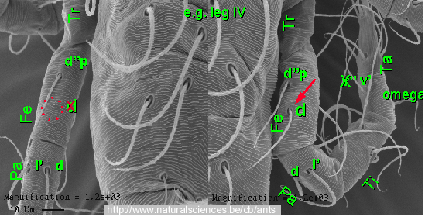
In mites variations in the form of unilateral or bilateral absences of exoskeletal elements (e.g. leg setae, solenidia, claws) are common and result in asymmetrical individuals. Asymmetry, more precisely fluctuating asymmetry (by contrast to directional asymmetry and antisymmetry), can be used as a measure of developmental stability.
Wauthy, G.; Noti,
M.-I. ; Leponce, M.; Bauchau, V. 1998 Taxy and variations of leg
setae and solenidia in Tetranychus urticae (Acari, Prostigmata). Acarologia, 39 : 233 –255. Leponce, M.; Noti, M.-I.; Bauchau, V.; Wauthy G.
2001. Vertition of integumental organs in mites revisited: a case of fluctuating asymmetry.
Comptes-Rendus de l'Académie des
Sciences, Paris, Sciences de la vie 324:425-431
Wauthy, G. ;
Leponce, M. ; Banaï, N. ; Sylin, G. ; Lions, J.C. 1998
The backward jump of a box moss mite. Proceedings of the Royal
Society, serie B. , 265 : 2235-2242. Wauthy, G.;
Leponce, M.; Banaï, N.; Sylin, G.; Lions, J.C. 1997 Le saut chez un
acarien oribate du genre Indotritia. Comptes Rendus de l’Académie
des Sciences de Paris, Sciences de la vie / Life Sciences, 320 :
315-317.
(Reprints available on
request)
|
 = click the ant icon to go back to home page
©
Royal Belgian Institute of Natural Sciences, last update 11 September 2003
Created and maintained by Maurice Leponce