|
Home
Site map
Intro/Staff
Databases
Projets
Documents
| |
Family ANATIDAE, swans, geese and ducks
Bewick's Swan, Cygnus
bewickii
This swan is breeding in the Eurasian tundra, from the Finno-Russian border to Central
Siberia. The birds breeding West of the Taymyr Peninsula are wintering mainly in Denmark,
the Netherlands, England and Ireland. A few birds also reach the Rhone Delta in southern
France. Elsewhere the species is of only very occasional occurrence during strong winters.
The total population visiting Western Europe is estimated at 17000 individuals, and seems
to be stable (Tucker & Heath, Scott & Rose).
----------------------------------------------------------------------------End-------------------------------------------------------------------------
Whooper Swan, Cygnus cygnus
This swan is breeding in the boreal regions of Eurasia, from Iceland and Scotland to
Kamchatka. Three distinct populations visit the European Union. The first one involves the
birds of Iceland, wintering in the British Isles and reaching probably Denmark and the
Netherlands. It is estimated at 16000 individuals, and seems to be stable. The second
population includes the birds of Scandinavia, Finland and Western Russia. Its winters
mainly in Denmark and northern Germany (Schleswig-Holstein and Mecklenburg). It is
estimated at 59.000 individuals, and has probably increased three times since 1970 (Laubch & al.). The third population
is breeding in western Siberia and wintering mainly in the Black Sea area. It is estimated
at 17000 individuals, and is probably declining (Scott & Rose). A few birds belonging
to this population regularly reach northern Greece (Handrinos & Akriotis).
NUTS |
MIN |
MAX |
R |
Scotland |
2 |
3 |
C |
|
----------------------------------------------------------------------------End-------------------------------------------------------------------------
White-fronted Goose, Anser
albifrons (see also Annex 2)
This goose is breeding in the tundra of northern Eurasia
and North America. Its nominate race can be hunted, and is included in Annex II. The race flavirostris
is included in Annex I, however. Its breeding grounds are along the West Coast of
Greenland, and it is wintering in the British Isles. After a strong decline during the
1960’s and 1970’s, its population has strongly increased and amounts again 30000
individuals (Scott & Rose, 1996).
----------------------------------------------------------------------------End-------------------------------------------------------------------------
Lesser White-fronted Goose, Anser
erythropus
This goose is breeding from northern Scandinavia to north-eastern Siberia. Its European
population is wintering west and south of the Black Sea and south of the Caspian Sea. It
has undergone a dramatic decline during the last 50 years, and the breeding population of
Sweden and Finland is now totalling less than 20 pair (EBCC Atlas of European Breeding
Birds). The reasons for this are not well known, but include increasing disturbance in the
breeding areas, unsustainable hunting and loss of habitat in wintering areas. Some
birds wintering currently in the Netherlands belong to a reintroduction project in Swedish
Lapland (von Essen, 1991)
----------------------------------------------------------------------------End-------------------------------------------------------------------------
Barnacle Goose, Branta leucopsis
This goose has three distinct populations (Scott & Rose). The first one, estimated
at 32000 individuals, is breeding in Greenland and wintering in Ireland and north-western
Scotland. The second, estimated at 12000 individuals, is breeding on Svalbard and
wintering in south-western Scotland. The third population, estimated at 176000
individuals, is breeding on the arctic coasts of Russia and Novaya Zemlaya and wintering
mainly in northern Germany and in the Netherlands. Since 1971 this species is also
breeding in the Baltic Sea (Sweden, Finland and Estonia) where its population amounted to
more than 2000 breeding pairs in 1994 (EBCC Atlas of European Breeding Birds). All
populations have considerably increased since the 1950’s, thanks to a better
protection of their habitats and a reduced hunting pressure.
----------------------------------------------------------------------------End-------------------------------------------------------------------------
Red-breasted Goose, Branta
ruficollis
This species is breeding in the tundra of northern Russia, more
precisely on the Taymyr, Gydan and Yamal peninsulas. It used to winter in large numbers
South of the Caspian Sea, and was known from Egypt and Iraq. Since the 1940’s and
1950’s it has shifted its winter quarters to south-eastern Europe, however, mainly to
Romania and Bulgaria. It also appears irregularly and in small numbers in Hungary, Greece
and Turkey. Its global population amounts to about 70000 individuals, but only a few
dozens or hundreds of birds (maximum 2000) are visiting the European Union, particularly
northern Greece (Handrinos & Akriotis, Scott & Rose). Following the strong decline
in the wintering areas South of the Caspian Sea the species was considered as endangered
(Collar et al. 1994, Green 1996), but the discovery of large wintering populations in
Romania makes this conclusion unlikely or exaggerated. In fact the actual trends of this
species are still unknown (EBCC Atlas of European Breeding Birds).
----------------------------------------------------------------------------End-------------------------------------------------------------------------
Ruddy Shelduck, Tadorna ferruginea
 |
A bird with a very fragmented distribution from
north-western Africa and south-eastern Europe to Central Asia, as far East as Lake Baykal
and Mongolia. A small population also exists in Ethiopia. The birds of north-western
Africa formerly also used to visit southern Spain in winter, but in this country
observations are currently only sporadic (Atlas de las Aves de España). In the European
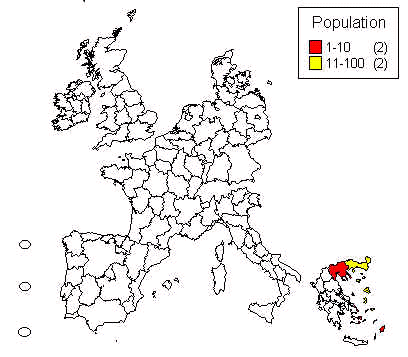
Union the species is today only occurring in Greece. These birds belong to the population
of the Black Sea and Eastern Mediterranean, which has undergone a strong decline during
the twentieth century, but seems currently to be quite stable. It is estimated at 20000
individuals (Scott & Rose). |
o
NUTS |
MIN |
MAX |
R |
Anatoliki
Makedonia, Thraki |
25 |
|
C |
Kentriki
Makedonia |
5 |
15 |
C |
Notio
Aigaio |
5 |
|
C |
Voreio
Aigaio |
10 |
30 |
C |
|
----------------------------------------------------------------------------End-------------------------------------------------------------------------
Marbled Duck, Marmaronetta angustirostris
 |
This duck has a strongly fragmented distribution covering
north-western Africa, the Iberian Peninsula, the eastern Mediterranean region, Turkey and
the Persian Gulf area, the Caspian Sea, Pakistan, northern India and western China.
Northern populations move to the South in winter, but their movements are poorly
understood since the species is quite nomadic. As to the species globally,
the populations of the western Mediterranean have strongly
declined during the last decades. They are estimated at not more than 3000 individuals,
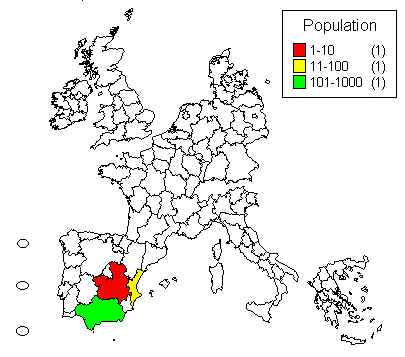
30-100 of which are still breeding in Spain (Scott & Rose). The few birds seen in
Greece (Handrinos & Akriotis) belong to the eastern Mediterranean population,
estimated at 1000 individuals (Scott & Rose). The decline of this species is linked to
the massive destruction of its habitats, over-hunting and pollution (Scott & Rose). |
o
| NUTS |
MIN |
MAX |
R |
Andalucia |
175 |
|
C |
Castilla la Mancha |
1 |
10 |
C |
Comunidad Valenciana |
13 |
29 |
C |
|
----------------------------------------------------------------------------End-------------------------------------------------------------------------
Ferruginous Duck, Aythya nyroca
 |
This diving duck has a wide distribution in the
temperate regions of Eurasia, from the Iberian Peninsula and the Baltic coast to Mongolia
and south-western China. Its European population, estimated at 10000 individuals, is
mainly wintering in the Mediterranean regions and in western sub-Saharan Africa. Its
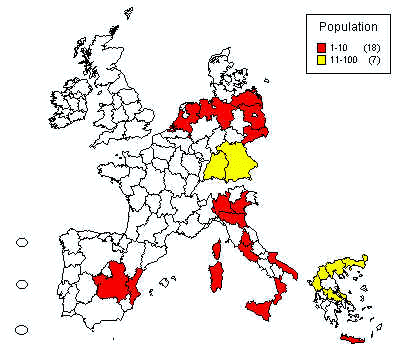
population of the European Union is strongly fragmented or even relict. In 1995 it could
be estimated at 340-560 breeding pairs, but everywhere this bird is still declining
(Tucker & Heath). |
o
NUTS |
MIN |
MAX |
R |
Nederland |
0 |
1 |
C |
Baden-Württemberg |
4 |
20 |
C |
Bayern |
4 |
20 |
C |
Brandenburg |
3 |
10 |
C |
Mecklenburg-Vorpommern |
0 |
5 |
C |
Niedersachsen |
1 |
5 |
C |
Sachsen |
4 |
20 |
C |
Corse |
0 |
1 |
C |
Calabria |
3 |
8 |
C |
Emilia Romagna |
3 |
8 |
C |
Lazio |
3 |
8 |
C |
Lombardia |
0 |
1 |
C |
Puglia |
3 |
8 |
C |
Sardegna |
3 |
8 |
C |
Sicilia |
3 |
5 |
C |
Umbria |
3 |
8 |
C |
Veneto |
3 |
8 |
C |
Castilla la Mancha |
1 |
5 |
|
Comunidad Valenciana |
1 |
5 |
|
Anatoliki Makedonia, Thraki |
30 |
50 |
C |
Dytiki Makedonia |
50 |
100 |
C |
Ipeiros |
5 |
20 |
C |
Kentriki Makedonia |
40 |
100 |
C |
Kriti |
1 |
2 |
C |
Sterea Ellada |
10 |
|
C |
|
----------------------------------------------------------------------------End-------------------------------------------------------------------------
White-headed Duck, Oxyura
leucocephala
 |
This duck has a strongly fragmented
distribution from the Iberian Peninsula and Tunisia to the Black Sea, the Caspian Sea, the
Persian Gulf and Central Asia. Some populations are sedentary. Others migrate, but their
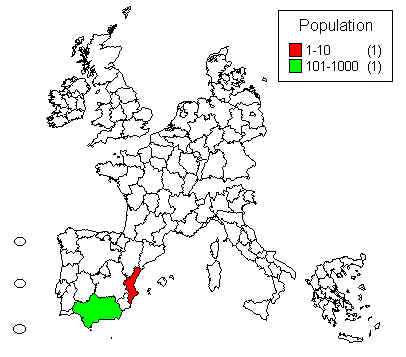
movements are poorly understood. The Spanish population declined from 400 individuals in
1950 to 22 in 1977. More recently it increased again to about 700 individuals thanks to
strong protection efforts (Scott & Rose). The birds seen during the winter in Greece
(Handrinos & Akriotis) belong to the population of the eastern Mediterranean, Turkey
and south-western Asia, estimated at 8000-15000 individuals (Scott & Rose).
Notwithstanding the recent increase in Spain and the apparent stability of the more
eastern populations, this species is considered as being endangered, because of its strong
decrease since the beginning of the twentieth century. This decline is mainly due to
massive habitat destruction and over-hunting (Scott & Rose). Since a few years the
Spanish population is also threatened by hybridisation with the Ruddy Duck, Oxyura
jamaicensis, an introduced species from America (Atlas de la Aves de España). |
NUTS |
MIN |
MAX |
R |
Andalucia |
500 |
|
I |
Comunidad
Valenciana |
1 |
2 |
C |
|
--------------------------------------------------------------------------
End ------------------------------------------------------------------------
Last update : 06/10/06
|
